
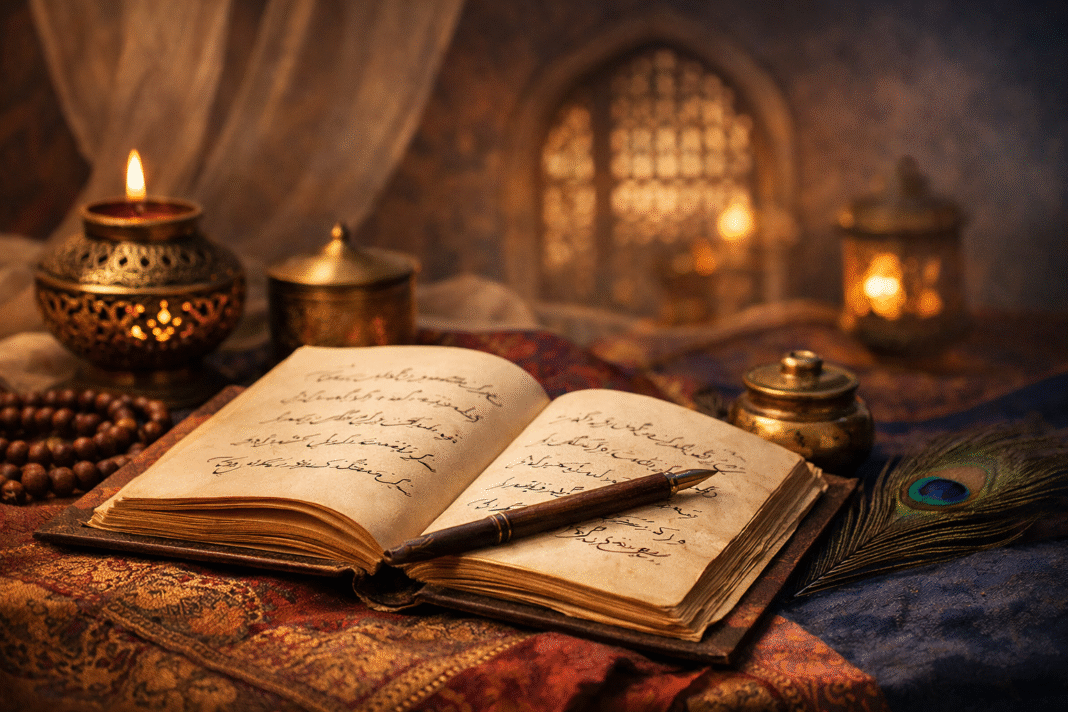

Shayari is more than poetry. In South Asia, it is memory, resistance, romance, and identity woven into words. From moonlit mehfils to bustling social media feeds, shayari continues to shape how millions express love, pain, devotion, and hope. Its endurance across centuries speaks to a deep-rooted cultural bond—one that refuses to fade with time.
What Is Shayari? More Than Just Poetry
At its core, shayari is a poetic expression rooted primarily in Urdu, Persian, Hindi, and related linguistic traditions. But reducing shayari to a literary form alone misses its true essence. Shayari is felt before it is understood. A couplet can carry generations of grief, or a single sher can revive forgotten love.
Unlike rigid poetic structures, shayari thrives on emotional honesty. It allows contradictions—strength in vulnerability, beauty in sorrow, and dignity in longing.
The Historical Roots of Shayari in South Asia
The journey of shayari in South Asian culture began centuries ago, influenced heavily by Persian poetry and later shaped by regional languages and experiences.
During the Mughal era, shayari flourished in royal courts, where poets were revered as intellectuals and cultural custodians. Names like Mir Taqi Mir, Mirza Ghalib, and Faiz Ahmed Faiz didn’t just write poetry—they documented social realities, philosophical dilemmas, and emotional truths of their times.
Shayari became a voice during periods of political upheaval, colonial resistance, and social reform. It was subtle yet powerful, poetic yet political.
Shayari as a Cultural Mirror
One reason shayari holds such a timeless bond with South Asian culture is its ability to reflect society without confrontation.
- Love and separation mirror societal norms and constraints.
- Sufi shayari reflects spiritual journeys and divine longing.
- Revolutionary shayari gives voice to suppressed emotions and resistance.
- Social shayari comments on class, injustice, and identity
Shayari doesn’t shout—it whispers truths that linger.
Shayari in Everyday South Asian Life
Shayari is not confined to books or academic discussions. It lives in everyday moments:
- A line of shayari shared after heartbreak
- A sher quoted during weddings
- Verses exchanged in late-night conversations.
- Poetic captions on Instagram and WhatsApp statuses
In South Asian households, even those who claim not to “read poetry” often remember at least one sher by heart. This effortless integration into daily life keeps shayari alive across generations.
The Emotional Language of the Masses
What makes shayari timeless is its emotional accessibility. You don’t need formal education to feel it. A single line can resonate with a laborer, a student, or a scholar alike.
Shayari captures emotions that are often difficult to articulate:
- Unspoken love
- Silent sacrifices
- Longing without expectation
- Faith amid despair
This emotional universality is why shayari transcends borders, religions, and dialects within South Asia.
Women, Shayari, and Changing Narratives
Traditionally dominated by male voices, shayari has evolved significantly. Contemporary South Asian culture has seen a powerful rise in women poets who redefine themes of love, autonomy, and resistance.
Modern shayari now challenges:
- Patriarchal romantic ideals
- Silent suffering
- Idealized heartbreak
This evolution reflects broader cultural shifts while preserving the soul of classical expression.
Shayari in the Digital Age
Far from fading, shayari has adapted beautifully to the digital era.
Platforms like YouTube, Instagram, and poetry apps have revived interest among younger audiences. Spoken-word shayari, reels, and short-form couplets prove that poetry can thrive even in fast-paced digital spaces.
Yet, despite the change in medium, the heart remains unchanged. The words still ache, heal, and inspire.
Why Shayari Will Never Lose Its Place in South Asian Culture
Trends come and go, but shayari endures because it fulfills a timeless human need—the need to be understood without explanation.
As long as people fall in love, feel loss, question faith, or seek meaning, shayari will remain relevant. It adapts, but it never disappears.
Final Thoughts: A Bond Written in Words and Souls
The relationship between shayari and South Asian culture is not preserved in museums or textbooks—it lives in hearts. It survives because it speaks when silence fails.
Shayari is not just read.
It is remembered.
It is felt.
And above all, it is lived.
That is why Shayari and South Asian Culture share a timeless bond—one that no era can erase.