
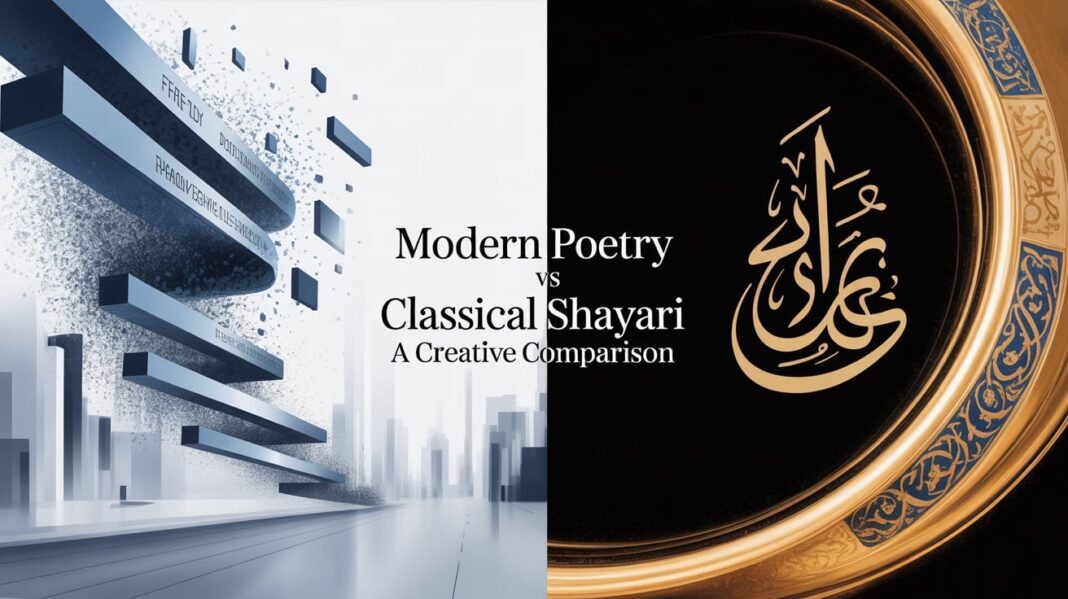

Poetry has always been the soul’s quiet rebellion against silence. Across centuries, cultures, and languages, humans have turned emotions into verses—sometimes bound by strict rules, sometimes liberated by free expression. Among the most fascinating contrasts in literary art is Modern Poetry vs Classical Shayari. Though both seek to express human truth, they do so through remarkably different philosophies, structures, and emotional landscapes.
This creative comparison explores how these two poetic worlds differ, overlap, and continue to shape the way we feel, think, and write today.
Understanding Classical Shayari: Poetry Rooted in Tradition
Classical Shayari originates from Persian and Urdu literary traditions and is deeply intertwined with South Asian culture. It is not just poetry—it is discipline, rhythm, and reverence.
Key Characteristics of Classical Shayari
- Strict Structure: Classical Shayari follows fixed poetic forms such as Ghazal, Nazm, and Qasida, governed by meters (beher), rhyme (qaafiya), and refrain (radeef).
- Timeless Themes: Love (ishq), separation (hijr), devotion, divine longing, fate, and existential sorrow dominate its verses.
- Symbolism: Wine (sharaab), the beloved (mehboob), the tavern (maikhana), and the candle (shama) are recurring metaphors layered with meaning.
- Musicality: Classical Shayari is meant to be recited aloud—its rhythm is as important as its meaning.
Legendary poets like Mirza Ghalib, Mir Taqi Mir, and Faiz Ahmed Faiz elevated Shayari into a refined emotional art form that still resonates today.
Exploring Modern Poetry: Freedom of Expression
Modern poetry emerged as a response to changing societies, individualism, and the breakdown of rigid artistic rules. It reflects the restlessness of contemporary life.
Defining Traits of Modern Poetry
- Free Verse: Unlike Shayari, modern poetry often rejects fixed rhyme schemes and meters.
- Personal Voice: The poet’s individual perspective, trauma, joy, confusion, or rebellion takes center stage.
- Contemporary Themes: Mental health, identity, politics, isolation, technology, love in the digital age, and social injustice are common subjects.
- Minimalism or Experimentation: Some modern poems are sparse and direct; others play boldly with form, spacing, and language.
Modern poets value authentic emotion over perfection, allowing readers to interpret meaning freely rather than guiding them through symbols.
Modern Poetry vs Classical Shayari: A Creative Comparison
| Structure | Highly formal, rule-bound | Flexible, often free verse |
| Language | Elegant, metaphor-rich | Direct, conversational, or experimental |
| Themes | Love, loss, mysticism, fate | Identity, society, self, modern struggles |
| Emotional Tone | Deeply romantic and philosophical | Intimate, raw, and reflective |
| Audience Experience | Meant to be savored and recited | Meant to be felt and interpreted |
While Classical Shayari invites admiration for its craftsmanship, modern poetry seeks connection through honesty and relatability.
Emotional Depth: Which Speaks Louder?
Classical Shayari often feels timeless—its sorrow and love seem infinite, echoing across generations. Modern poetry, on the other hand, feels immediate—it speaks directly to today’s anxieties and realities.
One is like a beautifully carved monument; the other, a handwritten note left on a bedside table. Both are powerful—just in different ways.
Cultural Influence and Evolution
Classical Shayari shaped literary gatherings (mushairas), music, and even everyday language. Many Urdu phrases used today come directly from Shayari.
Modern poetry thrives on blogs, books, spoken-word performances, and social media, making poetry more accessible than ever. It has democratized poetic expression, allowing anyone with a voice to be heard.
Interestingly, many contemporary poets blend both worlds—using Shayari-inspired metaphors in free verse or experimenting with modern themes within classical forms.
Which Is Better: Modern Poetry or Classical Shayari?
The comparison is not about superiority—it is about preference and purpose.
- If you admire discipline, layered meanings, and musical language, Classical Shayari may feel like home.
- If you value freedom, relatability, and emotional transparency, Modern Poetry might resonate more deeply.
Ultimately, both forms exist to do the same thing: make sense of the human experience.
The Future: A Creative Coexistence
Rather than competing, modern poetry and classical Shayari are increasingly influencing each other. Young poets are reviving classical forms with contemporary themes, while modern poets borrow Shayari’s emotional intensity.
This creative dialogue ensures that poetry remains alive, evolving, and relevant—honoring the past while speaking to the present.
Final Thoughts
Modern Poetry vs Classical Shayari: A Creative Comparison reveals more than stylistic differences—it highlights how humanity expresses emotion across time. One whispers through tradition; the other speaks boldly through change. Together, they remind us that poetry, in any form, is ultimately about truth, feeling, and connection.