
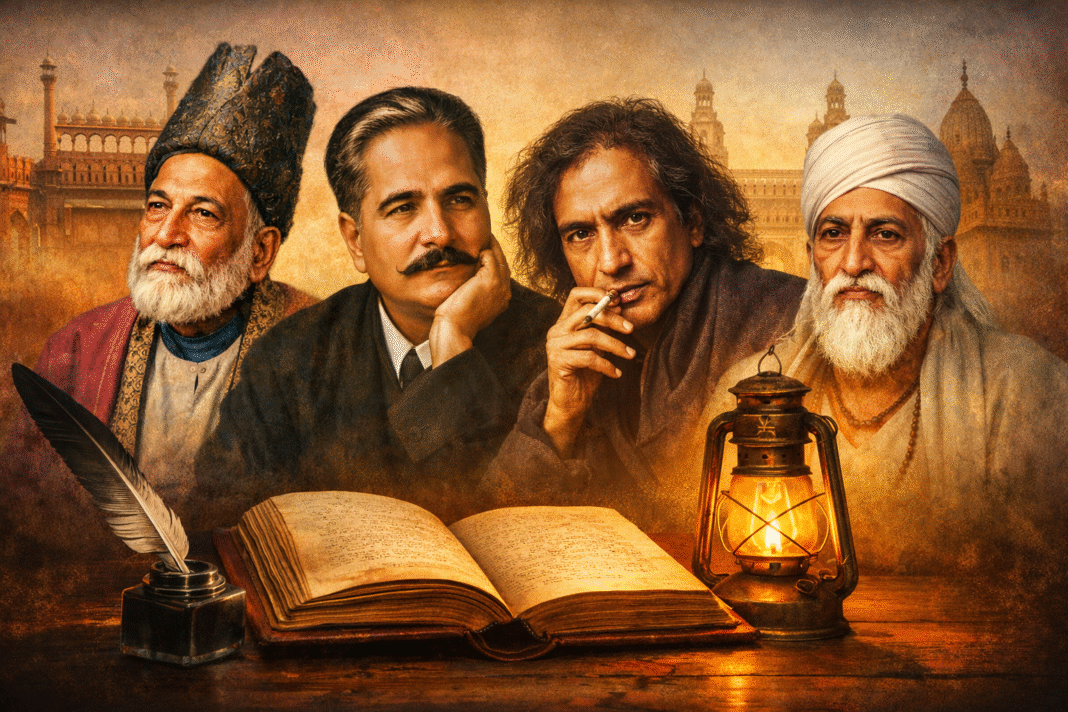

Urdu and Hindi poetry have never been just forms of artistic expression—they have been voices of rebellion, romance, spirituality, and social reform. Across centuries, certain shayars (poets) didn’t merely write verses; they reshaped literary traditions, influenced public thought, and redefined how emotions, politics, and philosophy could be expressed through words.
This article explores the most famous shayars who changed Urdu and Hindi poetry, examining how their ideas, styles, and courage transformed poetic landscapes and continue to inspire generations.
The Cultural Power of Shayari
Before diving into individual legends, it’s important to understand why shayari holds such a powerful place in South Asian culture.
Shayari has historically:
- Preserved language during political upheaval
- Served as resistance against oppression
- Given voice to love, loss, faith, and identity
- Bridged Urdu and Hindi audiences across regions
The poets below didn’t just master this art—they evolved it.
Mirza Ghalib: The Architect of Modern Urdu Poetry
No list of famous shayars is complete without Mirza Asadullah Khan Ghalib.
Why Ghalib Changed Poetry
Ghalib revolutionized Urdu ghazals by introducing:
- Philosophical depth over ornamental romance
- Complex metaphors rooted in existential thought
- A deeply personal, introspective tone
Unlike traditional poets who focused on external beauty, Ghalib explored inner conflict, doubt, and human frailty.
“Hazaaron khwaishein aisi ke har khwaish pe dam nikle…”
His work remains relevant because it speaks to universal human struggles—making him timeless.
Mir Taqi Mir: The Voice of Pain and Vulnerability
Often called “Khuda-e-Sukhan” (God of Poetry), Mir Taqi Mir laid the emotional foundation of Urdu poetry.
His Literary Impact
- Simplified language to make poetry emotionally accessible
- Centered heartbreak, loss, and loneliness
- Brought raw human emotion into ghazals
Mir’s poetry feels intimate, almost confessional, a quality that was revolutionary in its time. He taught poets that simplicity can be profound.
Allama Iqbal: The Poet Who Awakened Nations
Allama Muhammad Iqbal didn’t just write poetry—he sparked intellectual and spiritual awakening.
How Iqbal Transformed Urdu and Hindi Poetry
- Introduced philosophical and political themes
- Used poetry to promote selfhood (Khudi)
- Blended Islamic thought with modern philosophy
Iqbal’s verses motivated entire generations toward self-respect, action, and freedom. His poetry still echoes in classrooms, speeches, and movements.
Faiz Ahmed Faiz: Poetry as Resistance
Faiz Ahmed Faiz redefined poetry as a tool for social justice.
Why Faiz Was Revolutionary
- Combined romance with revolution
- Spoke against oppression, censorship, and inequality
- Made political poetry emotionally beautiful
Unlike loud protest poetry, Faiz’s resistance was subtle, lyrical, and deeply human.
“Bol ke lab azaad hain tere…”
Faiz proved that poetry could challenge power without losing grace.
Jaun Elia: The Poet of Modern Alienation
Among modern shayars, Jaun Elia stands apart for his unapologetic honesty.
Jaun Elia’s Contribution
- Expressed existential despair and self-criticism
- Broke romantic idealism
- Reflected postmodern disillusionment
Jaun’s popularity surged decades after his prime—proof that truth ages well, even if it’s uncomfortable.
Sahir Ludhianvi: The Rebel Lyricist
Sahir Ludhianvi bridged poetry and popular culture, influencing both Urdu literature and Hindi cinema.
His Lasting Impact
- Questioned capitalism, war, and religion
- Humanized poetry for the masses
- Refused to romanticize suffering
Sahir’s lyrics proved that commercial platforms could still carry intellectual depth and moral courage.
Kabir: The Timeless Mystic Poet
Though often categorized separately, Kabir profoundly influenced both Hindi and Urdu poetic traditions.
Why Kabir Still Matters
- Rejected religious orthodoxy
- Used everyday language
- Spoke directly to the common person
Kabir’s dohas remain relevant because they confront ego, hypocrisy, and blind faith—issues that transcend time.
How These Shayars Changed Poetry Forever
Collectively, these famous shayars transformed Urdu and Hindi poetry by:
- Expanding themes beyond romance
- Making poetry socially and politically conscious
- Blending philosophy with emotion
- Breaking linguistic and cultural barriers
They didn’t follow trends—they created them.
Why Their Influence Still Endures
Even today:
- Their verses dominate mushairas and social media.
- Their poetry is quoted in films, songs, and protests.
- New poets draw inspiration from their courage and honesty.
Great shayari doesn’t age—it evolves with the reader.
Final Thoughts
The famous shayars who changed Urdu and Hindi poetry didn’t just write beautifully—they thought bravely. They questioned norms, challenged power, embraced vulnerability, and used language as a mirror to society.
In an age of fast content and fleeting trends, their words remain slow, deep, and transformative—proof that true poetry never fades.